Professional marksmanship · Landscape-scale outcomes
Landscape-scale aerial wildlife management, delivered to mining, government and corporate-agriculture standards.
Specialist aerial marksmanship and control, built on Australian Government best practice with the operational discipline demanded by Tier-1 resource operators, councils, state agencies and broadacre agricultural corporations.
A$20M Public Liability · A$2M Professional Indemnity
Aviation
Own CASA ReOC (Part 101) · Contracted Part 138 AOC panel
01 — Executive summary
Who we are and what we deliver.
Greyman OPS is an Australian owned and operated specialist provider of aerial wildlife-management services, focused on landscape-scale management and humane destruction of invasive species — including feral pigs, deer, camels and other priority vertebrate biosecurity risks. We design and deliver programs that are strategic, humane, auditable and demonstrably cost-effective — not ad-hoc shoots bolted onto mustering or other activities.
Our work is evidence-led. It aligns with the National Codes of Practice and Standard Operating Procedures for the humane control of feral pigs, deer and other invasive vertebrates1,2,3. The National Feral Pig Action Plan identifies aerial shooting as “an effective and relatively cost-effective method of quickly reducing feral pig populations” in extensive or inaccessible country4.
$156M+Annual feral pig cost to Australian agriculture5
~45%Of Australia’s landmass occupied by feral pigs6
$2.5BWorst-case 30-year cost of ASF establishment7
<12 secBest-practice median time to incapacitation8
QuotedCosts vary by property and target species; contact us for a quote.
100%Greyman OPS safety record
Core services
Aerial and ground humane destruction programs at landscape scale. Thermal-assisted aerial culling (TAAC), ground-team support, program design, and in-house RPAS thermal surveys — pre-program density mapping and post-program outcome verification, flown under our own CASA ReOC — for feral pigs9, deer10, camels11, goats12 and other declared vertebrate pests.
Operating environments
Active mine leases, municipal land, national-park interface, broadacre cropping, irrigated horticulture, livestock grazing and environmental offset areas. Programs are designed against the species-specific National Codes of Practice and NATSOPs published on the PestSmart toolkits9.
Typical clients
Operating mines; regional, state and federal government; corporate agriculture; Natural Resource Management (NRM) groups; farming syndicates and other landscape-scale landholders.
Our major differentiators
Significant logistics resources — current Category C and D firearms, a substantial inventory of high-capacity magazines and spare parts — and accreditation depth that keeps the aircraft on target, not on the ground reloading, while meeting every welfare, safety and reporting obligation in writing.
02 — Track record
Our work in numbers.
Verified operational data from Greyman OPS programs — not estimates, not industry averages.
2018Established · Pty Ltd structure
5-strongSenior core team plus contracted AOC pilots
100%Greyman OPS safety record
2,000+Rounds of ready capacity per fuel cycle
3,000+Operational shooting hours
DozensLandscape-scale programs delivered
2.23Avg. shots per animal with fly-back protocol
6Regional helicopter staging bases
$20MPublic liability cover, plus $2M professional indemnity
Own ReOCCASA Part 101 Remote Operator’s Certificate
GDOC 26Bespoke autonomous drone deployment unit
5 statesQLD · NSW · VIC · SA · NT operating footprint
All figures verified against Greyman OPS company records, FeralScan survey reports, peer-reviewed literature and current insurance certificates. See the evidence base.
03 — About Greyman OPS
Credentials, accreditations and insurances.
Legal entity
Clearwater CFA Pty Ltd t/a Greyman OPS · ACN 619 194 964 · established 2018
Managing director
Adam Quinn, Managing Director & Head Marksman
Head office
Brisbane base · operations covering Qld, NSW, VIC, SA and NT · greyman.com.au
Core team
Five senior personnel — Project Leader / Lead Marksman, Ground Crew & Qualified Secondary Marksman, Operational Support, Technician & Trainer, and Chief Remote Pilot — with helicopter operations flown by pilots of contracted CASR Part 138 AOC holders, matched to the region of work. See Our team.
Coverage
National capability across Queensland (Brisbane base), New South Wales, Victoria, South Australia and the Northern Territory, with helicopter assets staged at Thredbo, Mundubbera, Longreach, Clermont, Toowoomba and Cairns for rapid regional mobilisation.
Insurance
A$20 million Public Liability · A$2 million Professional Indemnity held. Aviation liability insurance, aircraft maintenance records and pilot credentials are held by, and supplied for, the contracted CASR Part 138 AOC holder engaged for each program.
Contractor systems
Project Safety Plans integrate with Avetta, Cm3, Rapid Global and Pegasus.
Evidence pack
Certificates of currency, licences, accreditations and SWMS/JSA documentation supplied as a single pre-mobilisation bundle on request.
Accreditations and licences
Firearms licensing: licensed for occupational use of Category A, B, C and D firearms in QLD, NSW and SA; permits obtainable for VIC and NT on contract13.
AHCPMG311 Use firearms for aircraft pest control14.
AHCPMG304 Use firearms to humanely destroy animals.
Aviation (helicopter): contracted CASR Part 138 Aerial Work Certificate holders via our AOC panel15.
Aviation (RPAS): Greyman OPS holds its own CASA Remote Operator’s Certificate (ReOC) under CASR Part 101, with a dedicated Chief Remote Pilot.
Mining: Standard 11 (QLD), Common Induction (WA) and site-specific inductions as required under the NSW Work Health and Safety (Mines and Petroleum Sites) Regulation 202216.
Aircraft and AOC partners — right platform, right operator, right tenure.
Greyman OPS operates a flexible rotary-wing capability through a panel of contracted CASR Part 138 Aerial Work Certificate holders. The helicopter, AOC partner and staging base are matched to the terrain, program size, endurance requirement and client budget — not the other way round. NATSOP-PIG002 requires aircraft that are “manoeuvrable, fast and responsive, being suitable to the task at hand and operating environment”2; peer-reviewed programs achieving 100% incapacitation efficiency used the AS350 platform with a dedicated thermal operator8.
Queensland Helicopters — Longreach and Clermont. Coverage across western and central QLD.
Helicopters Australia — Toowoomba, QLD. Coverage across the Darling Downs and southern QLD.
HeliSurveys — Thredbo, NSW. Specialist partner for the alpine and southern-NSW operating zone.
All AOC partners hold Air Operator’s Certificates and CASR Part 138 instruments for low-level aerial work15; pairing is selected per engagement by location, endurance and client specification.
Platforms: Robinson R44 (cost-efficient), AS350 Squirrel (peer-reviewed benchmark TAAC platform8) and Bell 206L LongRanger (extended-range, multi-crew).
Sensors: thermal imaging deployed where conditions suit TAAC, consistent with NATSOP-PIG002 guidance on thermal binoculars and thermographer-equipped operations2.
Greyman OPS is a DJI Enterprise Dealer and operator — a meaningful differentiator from typical aerial-shooting contractors. UAV thermal surveys are flown before a destruction program to map distribution and density, and after to verify outcomes and inform follow-up. The data feeds directly into FeralScan and the client’s own GIS and biosecurity reporting17.
Own ReOC — all RPAS operations are conducted under our own CASA Part 101 aviation governance.
Current fleet: DJI Enterprise Matrice 400 and Dock 3 / Matrice 4 thermal — the latest-generation enterprise UAV stack with high-resolution thermal payloads.
GDOC 26 — our bespoke remote-autonomous drone operations system, housing two DJI Dock 3 platforms in a fully self-reliant deployable unit for unattended pre- and post-program thermal surveys in remote country, without on-site pilots.
Use cases: pre-program density mapping; thermal-aided target identification; post-program verification; remote-area baseline surveys; standalone biosecurity surveillance for mine leases and corporate-agriculture holdings.
Helicopter staging baseHead officeOperating states
Operating footprint
Five states. Six staging bases. One accountable operator.
Programs are mobilised from the staging base, aircraft and AOC partner best matched to the site — reducing ferry time, cost and mobilisation risk.
Head office
Brisbane, QLD
Southern QLD
Mundubbera, Toowoomba — Quidiron Helicopters, Helicopters Australia
Central & western QLD
Longreach, Clermont — Queensland Helicopters
Northern QLD
Cairns
Alpine & southern NSW
Thredbo — HeliSurveys
States covered
QLD, NSW, SA, VIC, TAS · permits obtainable for NT
04 — Our team
The people who make landscape-scale outcomes possible.
A small, deeply experienced five-person core team — supported by a panel of contracted CASR Part 138 helicopter operators, selected for each program by region, aircraft type and client specification.
AQ
Adam Quinn
Project Leader / Director · Lead Marksman
Founder and operational lead of Greyman OPS. Specialises in humane destruction of animals from aircraft, aerial-platform precision marksmanship, and feral-animal tracking and trapping at landscape scale.
Licences & permits: Occupational Firearms Licence Cat A/B/C/D, OCC, FA6, 999 Conditions; Commercial RPA Operator (RePL <150 kg); Standard 11; Work Safe Around Aircraft; 4WD Operation.
BN
Beau Nielsen
Ground Crew & Operational Support · Qualified Secondary Marksman
Highly experienced coal-mine worker and licensed electrician, inducted on multiple mine sites. Provides ground-crew and operational support, with full secondary-marksman qualifications when programs require it.
Licences & permits: Occupational Firearms Cat A/B/C/D; Humane Destruction of Animals (incl. from aircraft); aerial-platform precision marksmanship; Standard 11; Work Safe Around Aircraft; 4WD Operation; licensed Electrician.
DP
Darren Philip
Operational Support
Operational support across program delivery, ground logistics, firearms handling, and feral-animal tracking and trapping.
Licences & permits: Occupational Firearms Licence Cat A/B/C/D, OCC, FA6, 999 Conditions; Humane Destruction of Animals; Work Safe Around Aircraft.
DN
Darren North
Technician & Trainer
More than 30 years’ experience as a firearms instructor and trainer. Owner of PVO Training and the in-house training and currency lead for the Greyman OPS team, overseeing requalification and firearm maintenance.
Credentials: training accreditations provided in the pre-mobilisation evidence pack.
MT
Mike Thomas
Chief Remote Pilot
Leads Greyman OPS’s in-house RPAS / UAV capability under our own CASA ReOC — planning and flying pre- and post-program thermal surveys and managing the Dock 3 / GDOC 26 autonomous fleet.
Credentials: CASA remote-pilot licensing and ReOC scope provided in the pre-mobilisation evidence pack.
AOC
Contracted AOC partners
CASR Part 138 helicopter operators
Helicopter operations are flown by the pilots of contracted CASR Part 138 AOC holders, selected for each program by region, aircraft type, endurance and client specification. No single operator dependency.
Supplied per program: the engaged AOC holder’s certificate and Part 138 instrument, aviation liability insurance, aircraft maintenance records and pilot licences and experience.
Currency, on file. Every team member’s accreditation, last requalification date and benchmark scores are recorded and produced on request as part of the pre-mobilisation evidence pack — firearms licences, AHCPMG311 currency, medical fitness and SWMS/JSA documentation. Aviation documentation is supplied for the AOC holder engaged on each program.
05 — Capability pillar 01 · Logistics & capacity
Logistics and capacity — the misunderstood measures of efficiency and effectiveness.
Why programs with identical headline rates produce very different outcomes: the time the aircraft spends with a firearm ready to fire.
Aerial shooting is dominated by fixed costs. Aircraft hire, fuel and Marksman/observer crews are committed for every hour in the air18, and those costs don’t change whether the crew is engaging targets or reloading. The true measure of value is therefore cost per animal removed, not the hourly rate — and it is where Greyman OPS’s accuracy, efficiency and capability deliver optimal value. The variable is how much of each flight hour is actually spent engaging targets.
What the national SOP actually requires
NATSOP-PIG002 is explicit about the firearm configuration and the workflow around it — and the requirements are not optional:
“Rifles should be semi-automatic and of appropriate calibre e.g. .308 calibre and adequate magazine capacity.”2
“Shotguns should be 12-gauge and either pump action or semi-automatic… having an adequate magazine capacity — for use on small to medium sized pigs only.”2
“Each animal must be shot at least twice with at least one bullet placed in the heart/lung… before shooting further animals.”2
“A fly-back procedure is required after shooting a group of animals and must be applied at all times. The cost of ammunition and extra flying time must not deter operators from applying fly-back procedures.”2
Read together, these clauses require a Marksman to place at least two well-aimed rounds on each target in a group, then fly back and place additional rounds into any animal showing signs of life. On a mob of 15–25 pigs — a routine encounter on a productive aerial shoot — compliant engagement means 30–70+ rounds fired in sequence, often within 60–90 seconds, while the aircraft remains stable and on station.
Why magazine capacity matters more than most clients realise
If a Marksman is constrained to low-capacity magazines (five or ten rounds) or low round-count shotguns, the SOP-mandated workflow forces repeated reload cycles during active engagement. Each reload means the Marksman breaks aim, the aircraft breaks station or loiters unproductively, the group disperses, wounded or unconfirmed animals move into cover, and the fly-back becomes longer, slower and less reliable. The consequences are measurable and cumulative:
Welfare degradation. Reload pauses extend the window in which an impacted animal may be insufficiently confirmed — in direct conflict with the SOP’s fly-back mandate2.
Cost inflation. Every non-firing minute of flight is untargeted expenditure at the hourly helicopter rate. A program that spends 25% of flight time reloading pays a 25% “logistics tax” on every airframe hour.
Density sensitivity. Aerial shooting becomes less cost-effective as density falls2. Programs that fail to finish a mob on first contact leave education-hardened survivors that require disproportionately expensive follow-up.
Missed welfare targets. In peer-reviewed thermal-assisted programs using modern semi-automatic platforms, wounding was zero and median time to incapacitation was under 12 seconds8 — outcomes that cannot be replicated with under-resourced logistics.
12+ monthsFederal AG permit lead time per magazine batch
Greyman OPS has invested significantly in a 20-round rifle magazine inventory for the AR10 .308 platform — something that cannot be assembled at short notice or inside a tender response window. It provides more than 2,000 rounds of ready capacity per fuel cycle.
Why this is genuinely uncommon — the regulatory moat. In Australia, high-capacity centrefire rifle magazines (over 10 rounds) are restricted items requiring an Australian Government Attorney-General’s Department permit to import, in addition to state Category D firearms licensing. Permit processing for a single batch routinely takes twelve months or longer, with no guarantee of approval. Building a substantial inventory is therefore a multi-year exercise in regulatory persistence, federal compliance and capital commitment — not a procurement decision a new entrant can make on the back of a contract win.
The practical consequence: very few private operators in Australia hold the magazine inventory Greyman OPS holds. It is a structural, hard-to-replicate competitive advantage.
What 2,000+ rounds of ready capacity per fuel cycle buys you on the ground
A typical fuel cycle in an R44 or AS350 is roughly 2 to 2.5 hours of flight time before the aircraft must return to base or fuel cache. In that window:
The aircraft never grounds for ammunition. A sole operator with a 5-round shotgun reloads every five animals — dozens of reload cycles on a productive flight, each one a moment where the aircraft loiters and the group disperses. Greyman OPS swaps a 20-round magazine in seconds and continues the engagement.
Mobs are finished on first contact. SOP-mandated fly-back is impossible to execute properly when ammunition is rationed. Our capacity removes any temptation to cut corners on welfare2.
Every flight minute is spent shooting, not loading. Reloading time inflates the cost per animal; time on target drives it down.
Programs scale linearly, not in fits and starts. On landscape-scale projects — mining tenure, council aerial-cull blocks, broadacre cropping — the bottleneck is continuity: reloading, resupplying fuel and ammunition, or waiting on components pending federal approval. Greyman OPS removes that bottleneck with sufficient magazines, spare parts and equipment for continuous operations.
Translation for procurement and operational decision-makers
Mine environmental & HSE teams
A contractor that delivers SOP-compliant wildlife management without grounding for ammunition mid-shift is a contractor whose work plan you can schedule around.
Programs also reduce feral pigs on neighbouring properties — goodwill that supports community relations and your social licence to operate.
Council & agency biosecurity coordinators
Per-animal cost is a key metric in your acquittal. Costs vary by property and target species; contact us for a quote.
Corporate-agriculture program managers
Finishing mobs on first contact stops the educated-survivor problem — a population trajectory you can actually bend, not a treadmill you fund every season.
Tender evaluators
Ask every bidder: “How many high-capacity .308 magazines do you hold in current inventory, and how many years did it take to build?” The answer shows whether they can sustain SOP-compliant fly-back at scale.
Greyman OPS inventory — regularly updated
Primary rifle — Category D: AR10-platform semi-automatic .308 Win. Professional-grade reliability, purpose-matched to the NATSOP-PIG002 specification2.
Secondary firearm — Category C: Benelli semi-automatic 12-gauge shotgun firing 12-pellet buckshot for humane dispatch of small through to large animals at close range.
Magazine inventory: a substantial quantity of high-capacity 20-round magazines for the .308 AR10 platform.
Per-fuel-cycle capacity: more than 2,000 rounds in ready-loaded magazines staged in the airframe per refuel.
Ammunition: .308 calibre as specified in the NATSOP-PIG002 firearm/ammunition table2, with locked firearm and ammunition storage compliant with the SOP and state legislation.
Fleet depth: multiple semi-automatic AR10 rifles and shotguns — supporting simultaneous multi-crew operations, zero-downtime substitution during maintenance, and the SOP’s two-firearms-per-Marksman standard2.
Bottom line for decision-makers.The cheapest quote per hour is rarely the cheapest program. Programs that under-invest in experienced technicians and pilots, firearms and high-capacity magazines spend the hourly helicopter rate on reloading and repositioning rather than targeting. Greyman OPS’s risk management, program planning and delivery, experienced crew and 2,000+ rounds of ready capacity per fuel cycle — built up over years — are why a Greyman OPS aircraft removes more animals per airframe hour, at a lower per-animal cost.
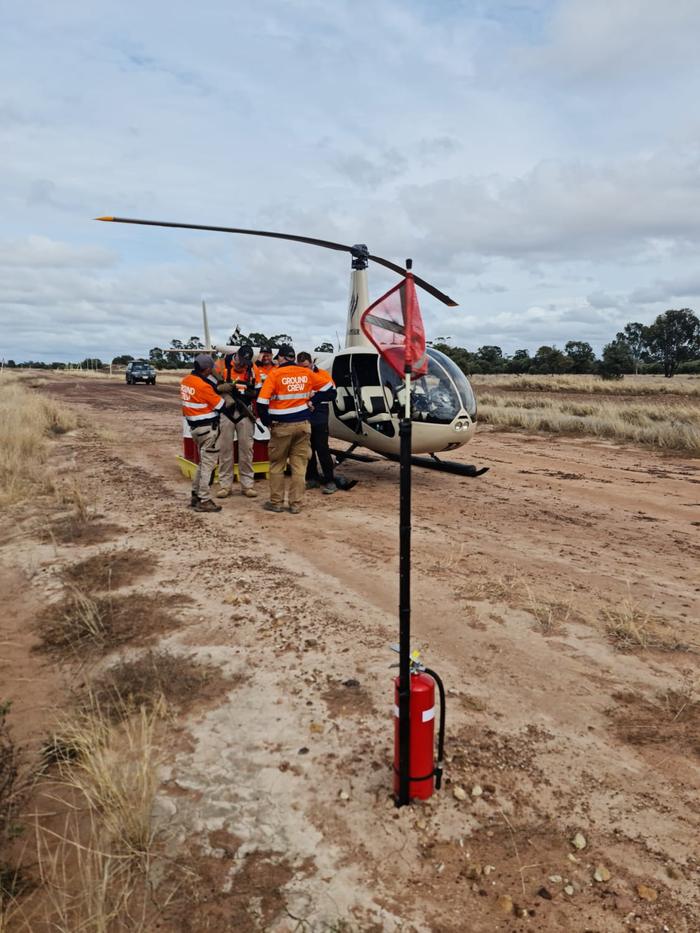
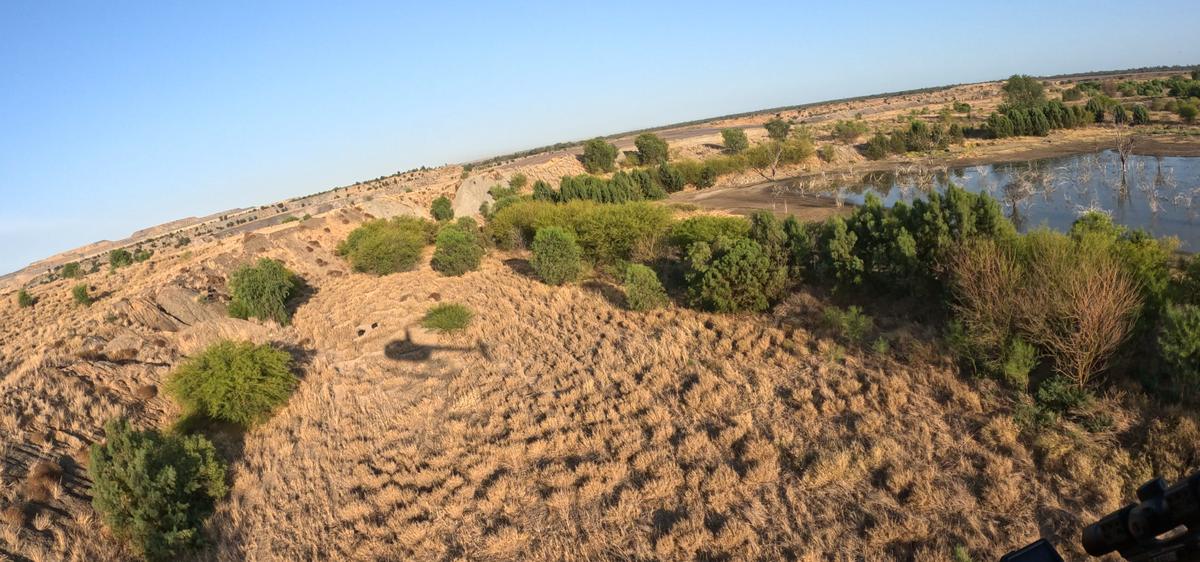
Forward fuel cache. Ground crew turn the aircraft around at a field fuel point.On station. Low-level aerial operations over mine rehabilitation and spoil country.
Before comparing operators, the first procurement question is: which methodology actually moves the population? The evidence base is clear — aerial shooting delivers landscape-scale reduction quickly, with auditable welfare outcomes. Ground shooting, trapping and baiting have specific roles, but as the primary knock-down tool they are slower, less effective and harder to audit.
Factor
Ground shooting
Trapping
Baiting (1080 / PAPP / sodium nitrite)
Aerial shooting
Coverage rate
Slow — vehicle-bound and terrain-limited; typically a few hundred hectares per day in accessible country.
Very slow — site by site; effectively zero per-day coverage at landscape scale.
Wide passive coverage along bait lines, but no direct targeting; outcomes lagged and inferred.
Thousands of hectares per day — “best suited to areas where pigs are living and feeding in extensive or inaccessible areas”2.
NATSOP-PIG002 — a dedicated, nationally endorsed aerial-specific SOP2.
Swipe the table sideways to see all columns →
Methodology bottom line.Aerial shooting is the most cost-effective methodology for rapid, landscape-scale reduction of feral pig and deer populations across extensive or inaccessible country — and the foundation of major Australian programs, from the National Feral Pig Action Plan4 and National Feral Deer Action Plan 2023–2820 to the NSW Government’s A$13.1M Feral Pig and Pest Program 2024–2521. Per-animal cost rises as density falls below approximately 2–6 pigs/km²22, which is why aerial is best deployed as the primary tool in an integrated program, complemented by ground shooting, trapping and baiting for follow-up and infill23. At landscape scale, it is the methodology that stands up in front of an internal auditor, a board, a regulator or an FOI request.
05 — Capability pillar 01 · Operator comparison
The honest comparison — what a procurement officer is actually choosing between.
Once aerial shooting is the chosen methodology, the second question is which operator. The Australian aerial feral-animal market spans a wide range of capability; a clear-eyed comparison is the fastest route to a defensible procurement decision.
Operational factor
Greyman OPS
Typical sole operator
Team
Five-person senior core team — Lead Marksman, Secondary Marksman, Operational Support, Technician & Trainer (30+ years’ instruction) and Chief Remote Pilot — flown by pilots of the contracted Part 138 AOC holder best matched to the region of work.
Benelli M4 / M2 semi-auto 12-gauge (Cat C) — meeting the SOP’s two-firearm requirement2.
Rarely carried.
Rounds between reloads
20 — switched in seconds from a staged magazine.
5 (shotgun tube capacity).
Ready capacity per fuel cycle
2,000+ rounds across a substantial inventory of 20-round magazines.
~5–50 rounds in pocket or pouch; constant reloads.
Aircraft
R44, AS350 Squirrel and Bell 206L LongRanger — matched to terrain, endurance and budget.
Usually a single R22 or R44, owner’s aircraft.
Regional staging
Six staging locations — Thredbo, Mundubbera, Longreach, Clermont, Toowoomba and Cairns — supporting a five-state footprint.
One home base.
SOP-mandated fly-back
Standard on every mob engagement — never ammunition- or magazine-limited.
Often curtailed when ammunition or time is tight2.
Two-firearm compliance
Built into the sortie load-out, with fleet redundancy for maintenance substitution.
Frequently absent.
Mine-site / WHS
Documented Project Safety Plans integrated with Avetta, Cm3, Rapid Global and Pegasus; WHS (MPS) Regulation 2022 compliant16.
Ad-hoc inductions; limited SMS integration.
Data deliverable
GPS flight tracks, time-stamped kill locations, heat maps, ammunition reconciliation and fly-back confirmations via FeralScan / FeralPigScan17 and CSIRO-lineage tools24.
Verbal debrief; paper tally; sometimes a photograph.
Insurance
A$20M Public Liability; A$2M Professional Indemnity; aviation liability, maintenance records and pilot credentials supplied for the engaged Part 138 AOC holder.
Variable — sometimes minimal or absent.
Welfare accountability
Written post-operation report against SOP criteria: numbers, locations, hours flown, ammunition used, fly-back evidence2.
Self-reported.
Swipe the table sideways to see all columns →
This is what professional, landscape-scale aerial wildlife management looks like. A properly accredited Marksman team; the capacity to deliver SOP-mandated two-shots-per-animal engagement and compliant fly-back on every mob; and an auditable data trail handed to the client at the close of every program. Team, firearms, magazines, aircraft, tracking and paperwork operate as a single integrated system — because that is what the evidence base and the regulations require, and what landscape-scale outcomes demand.
06 — Capability pillar 02 · Safety & risk
Built for mining and heavily regulated clients.
Aerial shooting is, by the plain text of the national SOP, a “potentially hazardous” activity2. Our systems treat it that way.
Aviation compliance
Every Greyman OPS flight is conducted under a CASR Part 138 Aerial Work Certificate holder. Under Part 138, an operator conducting aerial work in Australia must hold an aerial work certificate granted by the Civil Aviation Safety Authority15. The SOP reinforces this: “Helicopter operators must have approval from the Civil Aviation Safety Authority to undertake aerial shooting operations.”2
Part 138 operations-manual alignment, including task-specialist procedures for aerial shooting.
Documented pre-flight briefing for every mission — communication protocols, pre-shot manoeuvre, firing commands and emergency procedures, per NATSOP-PIG0022.
Flight and duty time and fatigue management, with a maximum of six hours’ flight time per Marksman day, consistent with published Australian aerial-culling practice18.
WHS and mine-site readiness
On NSW mine and petroleum sites we operate inside the operator’s safety management system under the Work Health and Safety (Mines and Petroleum Sites) Regulation 2022, which requires contractors to be inducted, given risk information and monitored for compliance with the SMS, emergency procedures and withdrawal protocols16.
Job Safety Analyses (JSA) and Take-5 before every task; firearm-specific risk controls for live-site operations.
Designated firing arcs, exclusion zones and ground-team communication through mine radio channels.
Locked firearm and ammunition storage in accordance with the SOP and state legislation2.
Inductions kept current: Standard 11 (QLD coal), Common Induction (WA), site-specific refreshers; White Card; RIIWHS205D.
SOP-mandated PPE: flight helmet with intercom, fire-resistant flight suit, harness, boots, gloves, eye and hearing protection, emergency locator beacon, first-aid and survival kits2.
Documented, auditable, client-facing. Every Greyman OPS program arrives with a written Project Safety Plan that integrates with the client’s contractor-management system (Avetta, Rapid Global, Pegasus or Cm3 as applicable). Pre-mobilisation evidence packs — firearm licences, AHCPMG311 currency, medical fitness, Greyman OPS insurances, SWMS and JSA, plus the engaged AOC holder’s certificate, aviation insurance, aircraft maintenance records and pilot credentials — are provided as a single document bundle, so procurement and HSE teams can clear us in hours, not weeks.
Animal welfare and marksmanship — evidence, not assertions.
Humane outcomes are the product of accredited Marksmen, the correct platform, correct calibre and ammunition, correct shot placement and disciplined fly-back.
Accreditation standard
Greyman OPS Marksmen hold, at minimum, the nationally recognised units of competency AHCPMG311 Use firearms for aircraft pest control14 and AHCPMG304 Use firearms to humanely destroy animals. Each Marksman is individually currency-tracked: every requalification date and benchmark score is recorded and produced on request.
In line with NATSOP-PIG002, every Marksman must consistently place a group of three rounds (from three attempts) within a 7.5 cm target at 100 m from a bench rest using the minimum specified centrefire rifle2 — a benchmark we verify at every refresher and record against each team member.
Shot placement and ammunition
Only chest (heart-lung) or head (brain) shots are used, per NATSOP-PIG0022. The “deliberate overkill” policy — at least two rounds per animal, including at least one heart-lung round — is followed without exception, with ammunition selected for rapid, humane incapacitation.
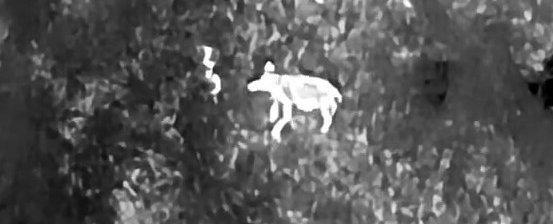
Thermal drone detection. Feral sow with three piglets.
What good welfare outcomes look like in the data
The current peer-reviewed benchmark for aerial culling of feral pigs and deer in Australia is Cox et al. (2023), published in Scientific Reports8. Using a thermal-assisted configuration on an AS350 B3 helicopter with a .308 self-loading rifle and 135-grain hollow-point ammunition, the program achieved:
100%Incapacitation efficiency (both species)
0Wounded animals
11.5 sMedian time to incapacitation (pigs)
2×Culling rate vs visual-only shooting
These are the numbers that should be the yardstick for any modern aerial program. They are achievable only when the Marksman, platform, sensor package, firearm and logistics are all aligned — precisely the operating envelope Greyman OPS is built around.
Currency, training and pre-mobilisation requalification
Welfare and safety outcomes in aerial shooting decay quickly without continuous practice. Greyman OPS treats Marksman and support-crew currency as a year-round program, not a one-time accreditation.
4/yr minimumScheduled requalification courses
In-aircraftLive-fire requalification, not bench-only
<2 weeksRequalification before every major program
Year-round requalification cycle. Marksmen and support crew complete formal requalification a minimum of four times a year — marksmanship to the NATSOP-PIG002 7.5 cm / 100 m benchmark2, firearm-handling discipline, fly-back procedure, communication protocols and emergency drills.
Live in-aircraft requalification. Requalification is conducted from the helicopter shooting platform itself, replicating the operating environment described in NATSOP-PIG002 — low-level flight, proximity to obstacles, firing from a moving aircraft2. It is the only way to maintain genuine aerial-marksmanship currency.
Pre-mobilisation requalification within two weeks of every landscape-scale program. No Greyman OPS Marksman flies a major program without a live-fire, in-aircraft requalification in the preceding fortnight, verified and recorded against the program file.
Support-crew currency. Pilots, observers and ground crew complete parallel cycles — pre-flight briefings, communications, fuel-cache procedures, locked firearm and ammunition handling, and emergency response — per the SOP’s WHS requirements2.
Auditable training records. Currency, last requalification date and benchmark scores are produced on request as part of the pre-mobilisation evidence pack.
Why this matters to the client. The peer-reviewed welfare numbers above8 are not achievable on bench-rest training alone — they require Marksmen who are currently and recently shooting from helicopters. Our pre-mobilisation requalification cycle turns those benchmarks from possibility into program-day reality.
On accountability. NATSOP-PIG002: “Aerial shooting programs by their nature must be highly accountable… records should be kept of the number and location of animals killed, hours flown, ammunition used and fly-back procedures.”2 Every Greyman OPS engagement includes a written post-operation report containing precisely this data set.
Field evidence — what programs are up against
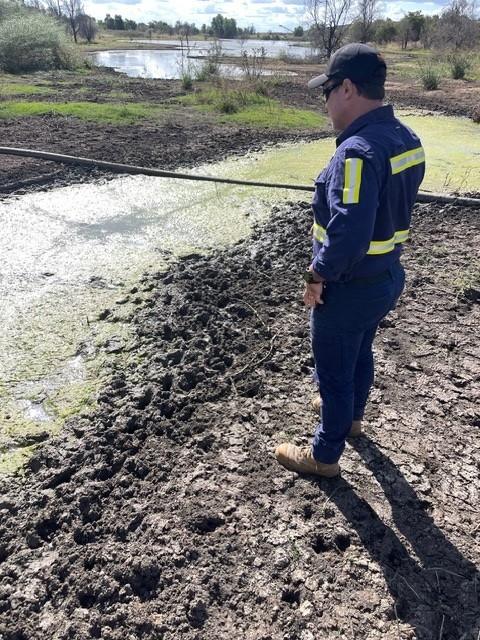
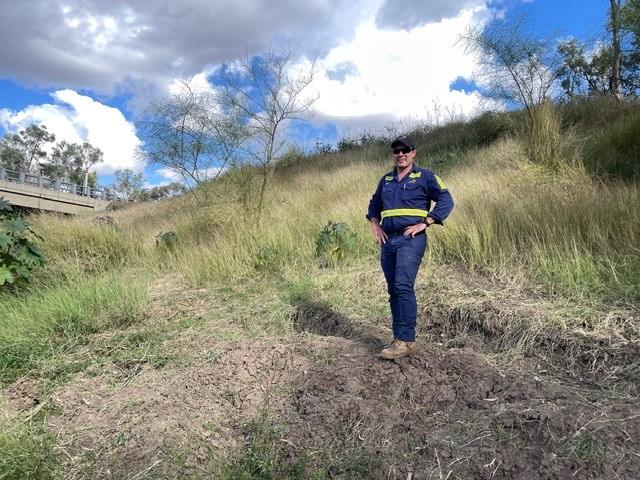
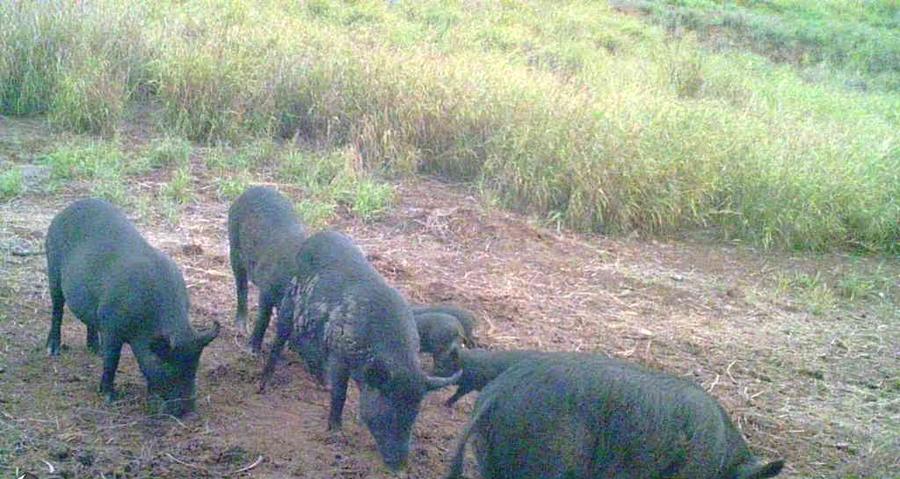
Wallowing damage around a water body.Rooting damage on an embankment near road infrastructure.Trail-camera detection of a feral pig mob.
08 — Capability pillar 04 · Data, reporting & value for money
Aerial programs are only defensible when the numbers are.
We deliver the kind of data that survives internal audit, board scrutiny and FOI.
Our standard reporting deliverables
Greyman OPS captures all field data through FeralScan / FeralPigScan17 — the national pest-mapping platform built on Centre for Invasive Species Solutions and CSIRO-lineage research infrastructure24. Every flight path and every animal taken is GPS-tagged at source and lands in a nationally consistent data set that clients can trust, audit and hand to their own regulators.
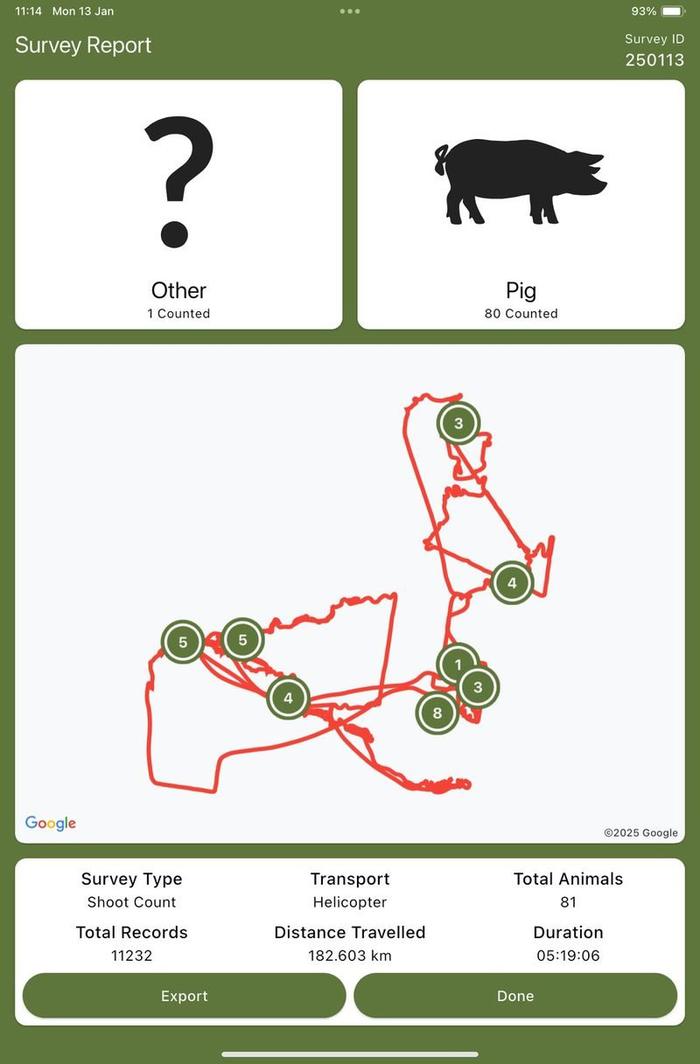
Survey 250113 — Moree, NSW. 81 animals (80 pigs, 1 other) · 182.6 km tracked · 5 h 19 m · 11,232 GPS records.
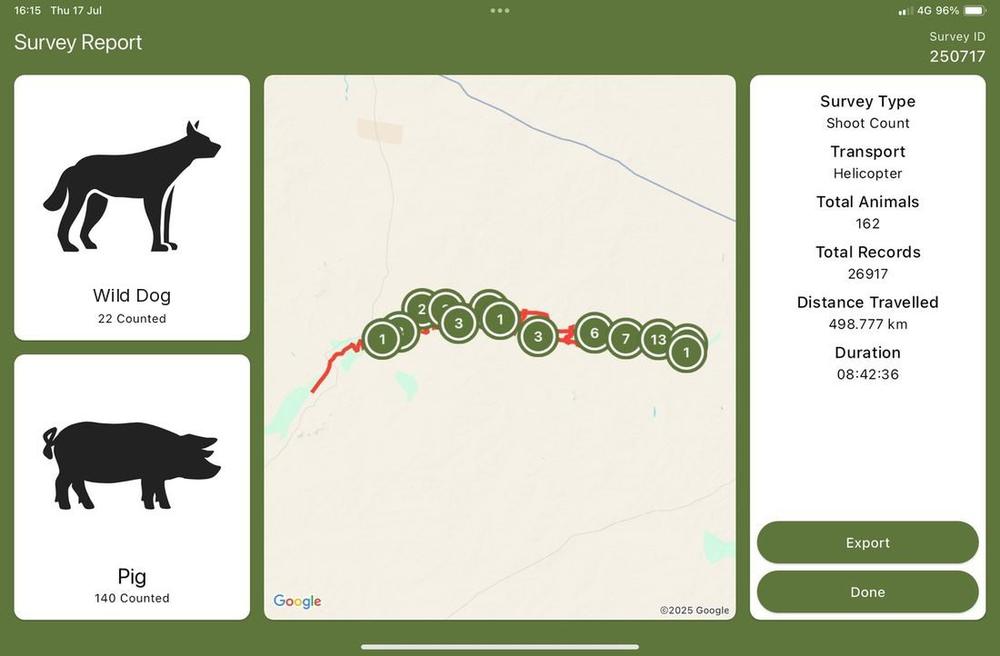
Survey 250717 — Longreach, QLD. 162 animals (140 pigs, 22 wild dogs) · 498.8 km tracked · 8 h 42 m · 26,917 GPS records.
Two real Greyman OPS programs at different scales. This is the exact data set provided to the client after every engagement — auditable, time-stamped and nationally consistent through FeralScan / FeralPigScan17.
Case study · Blackwater, QLD
Over 1,511 feral pigs, plus wild dogs and feral cats, have been removed across three mine leases and neighbouring properties near Blackwater since 2023, through aerial, ground-thermal and baiting programs. Neighbouring landholders have been very positive about the regional reduction in feral pigs — and because aerial shooting does not disperse survivors19, the reduction holds.
Core deliverables
Daily totals of animals removed — time-stamped, species-coded counts captured in FeralScan as the primary record.
GPS flight track data — full flight log (KML/GPX) and map overlays, supporting accurate recording and eliminating the risk of shooting in off-target areas2.
Total time over each property and total ammunition used — flight time logged per property; ammunition reconciled against kill count per the SOP2.
Fly-back confirmations — recorded against each mob engagement.
Welfare exception reports — any deviation from the SOP documented, with root cause and corrective action.
Optional data available
Pre & post RPAS thermal survey / verification — in-house UAV thermal mapping (DJI Matrice 400 / Dock 3) under our own CASA ReOC — baseline density before the program, verified outcomes after.
Heat maps & density inference — pre/post comparison where baseline data exists.
Video footage / evidence — recorded engagement footage to support audit and acquittal.
Client-format data transfer — outputs delivered into FeralScan, Local Land Services biosecurity registers, council systems or mine-site GIS as required.
Value-for-money economics
ABARES estimates feral pigs cost Australia’s agricultural sector more than A$156 million per year in control costs and production losses, and vertebrate pests collectively cost landholders around A$866 million every year5. Layered on top is an African Swine Fever exposure estimated by the federal agriculture portfolio at between A$439 million and A$2.54 billion over 30 years in the worst-case endemic scenario7.
The economics of aerial shooting are well documented:
Aerial shooting is “a cost-effective method where pig density is high or the area is inaccessible” — but “costs per pig increase as pig density decreases”2.
Helicopter operating costs accrue for every hour in the air18. The accuracy, efficiency and capability of the crew determine whether those hours buy animals removed — or reloads.
Aerial shooting does not materially disperse surviving pigs or change their movement patterns, so knock-downs are bankable and follow-on programs can be planned against a stable population geography19.
Our value-for-money proposition. Put Greyman OPS alongside the cheapest quote in front of you, then compare on animals removed per dollar, SOP-compliant fly-back rate and audit-ready reporting. That is the comparison that matters to a procurement officer, an HSE manager, a biosecurity coordinator and a shareholder alike.
How a Greyman OPS program runs
01
Discovery & scoping
Discovery call, then a scoping visit inside two weeks covering species, tenure, access and risk appetite.
02
Baseline survey
Pre-program RPAS thermal survey maps density and distribution under our own ReOC.
03
Design & safety
Written program design, Project Safety Plan and pre-mobilisation evidence pack, integrated with your contractor system.
04
Requalify & mobilise
Live-fire, in-aircraft requalification within two weeks; 72-hour mobilisation window.
05
Deliver
SOP-compliant aerial program — two-shot minimum, fly-back on every mob, every animal GPS-tagged in FeralScan.
06
Verify & report
Post-program thermal verification and a written post-operation report in your required format.
09 — Client sectors
Built around the three sectors that take this work seriously.
Mining & resources
Tier-1 and Tier-2 operators
Aerial feral-animal programs delivered on live mine leases across our QLD, NSW, VIC, SA and NT operating footprint. Work integrates with the mine safety management system — including obligations under the WHS (Mines and Petroleum Sites) Regulation 202216 — and with contractor-management platforms such as Avetta, Cm3, Rapid Global and Pegasus. Neighbouring landholders share the benefit.
Government
Councils, LLS and state agencies
Delivery for regional councils, Local Land Services regions and state agencies — including integrated programs combining landholder engagement, baiting coordination and aerial shooting phases. Outputs align with LLS reporting formats and FeralScan, and deliverables are structured for internal audit, community reporting and FOI defensibility.
Corporate agriculture
Broadacre and irrigated
Programs for corporate agricultural groups managing livestock grazing, broadacre cropping, cotton, sugar and horticulture. Aerial shooting is “best suited to areas where pigs are living and feeding in extensive or inaccessible areas (e.g., swamps, marshes and rough terrain or broadacre crops) where vehicle access is impossible or impractical”2 — precisely these holdings.
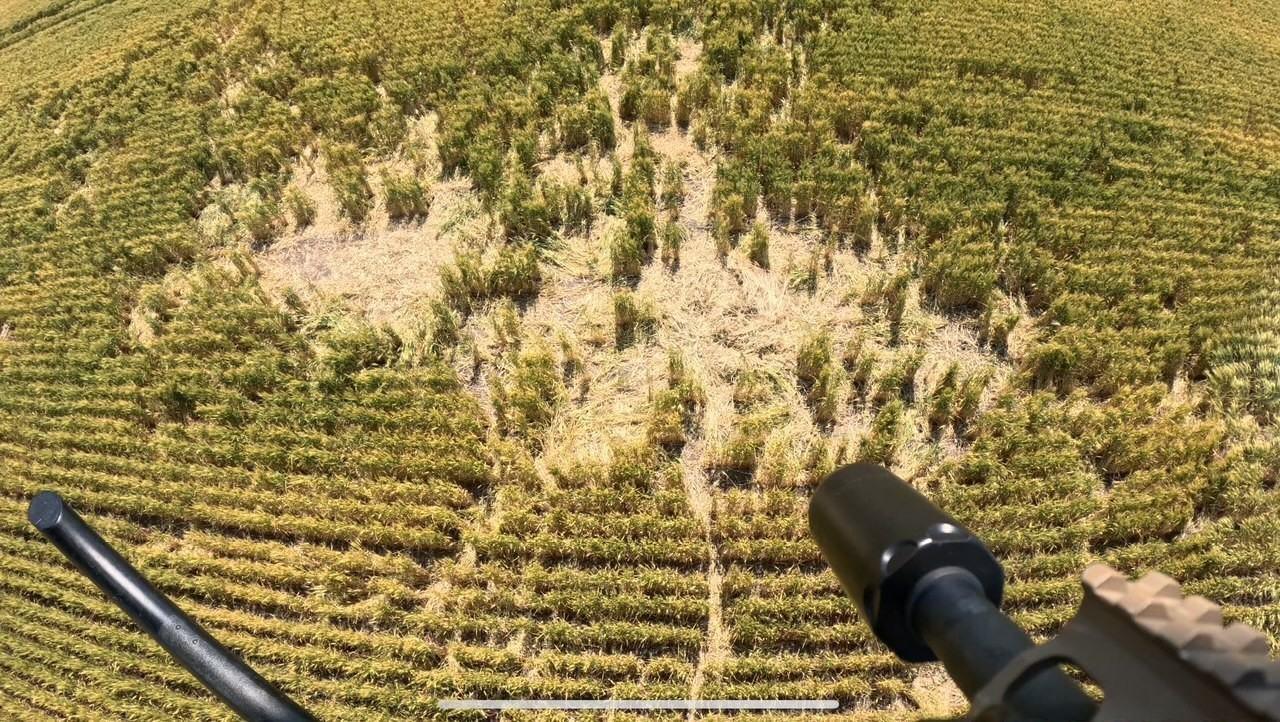
Feral-pig damage in a standing grain crop — Moree, NSW. Aerial view from a live Greyman OPS operation. A single mob can flatten multiple hectares of high-value crop in a night; ABARES estimates feral pigs cost Australian agriculture more than A$156 million per year5. This is the problem Greyman OPS programs are designed to reduce at landscape scale.
Species
Feral pigs, deer, camels, goats and other declared vertebrate pests
Footprint
QLD (base), NSW, SA, VIC and TAS; permits obtainable for NT
Mobilisation
72-hour mobilisation window available; scoping visit inside two weeks
Engagement & contact
Scope a program with us.
We scope every program on the ground truth of your property, your tenure and your risk appetite.
Step 1
Discovery call
Typically 30 minutes to understand species, tenure, access and objectives.
Step 2
Scoping visit
Mobilised inside two weeks; baseline RPAS thermal survey where required.
Step 3
Program proposal
Written program design, Project Safety Plan and pre-mobilisation evidence pack.
The full statement (PDF) covers credentials, team, capability pillars, safety, welfare data and references. Enter your business email and we’ll send you the download link.
We use your details to send the document and follow up about your program. See our Privacy Policy.
Evidence base & references
Full references cited on this page.
Greyman OPS draws its operational design directly from the Australian national and state evidence base. The primary sources underpinning this page — codes of practice, standard operating procedures, peer-reviewed science, government reports, aviation and safety regulation, accreditation standards and data platforms — are listed below, numbered in order of first citation.
NSW Department of Primary Industries. NSW PIGCOP — Code of Practice and Standard Operating Procedures for the Effective and Humane Management of Feral Pigs, SOP2: Aerial Shooting of Feral Pigs. NSWPIG-SOP2 (PDF)
The Hon. Murray Watt MP, Minister for Agriculture, Fisheries and Forestry. ABARES: potential economic consequences of African Swine Fever (media release). minister.agriculture.gov.au — ASF release
Cox, T.E., Matthews, R., Halverson, G., Morris, S. (2023). “Thermal aerial culling for the control of vertebrate pest populations.” Scientific Reports 13, 10063. Key findings: culling rate doubled vs visual-only shoots; zero wounding; 100% incapacitation efficiency; median time to incapacitation <12 s; AS350 B3; .308 self-loading rifle; 135-gr hollow-point. nature.com/articles/s41598-023-37210-0
PestSmart / Centre for Invasive Species Solutions. Feral deer management toolkit — National Code of Practice, NATSOPs for aerial shooting, ground shooting and trapping; DeerScan. pestsmart.org.au/toolkits/feral-deer
PestSmart / Centre for Invasive Species Solutions. Feral camels management toolkit — National Code of Practice; NATSOPs for ground and aerial shooting, mustering and field immobilisation. pestsmart.org.au/toolkits/feral-camels
PestSmart / Centre for Invasive Species Solutions. Feral goats management toolkit — National Code of Practice; NATSOPs for ground and aerial shooting, mustering and trapping. pestsmart.org.au/toolkits/feral-goats
FeralScan / FeralPigScan — national pest-mapping platform managed by the Centre for Invasive Species Solutions with support from the Australian Government and state agencies. feralscan.org.au/feralpigscan · PestSmart FeralPigScan
Bengsen, A.J., Forsyth, D.M., Harris, S., Latham, A.D.M., McLeod, S.R., Pople, A. (2022). “Effectiveness and costs of helicopter-based shooting of deer.” Wildlife Research WR21156. publish.csiro.au/WR/WR21156
McMahon, S., Matthews, R., Sparkes, J., Cowled, B., Ballard, G. (2025). “Aerial shooting is unlikely to cause dispersal or consistent changes in the movements of feral pigs (Sus scrofa).” Wildlife Research 52(6), WR25024. publish.csiro.au/WR/WR25024
National Feral Deer Management Coordinator. National Feral Deer Action Plan 2023–28 — identifies aerial culling (with thermal support) as the primary tool for rapid knock-down. See also McLeod (2023) Annual Costs of Feral Deer in Australia, CISS: A$91.3M cost in 2021. National Feral Deer Action Plan (PDF) · Cost of Feral Deer report (PDF)
NSW Local Land Services. Feral Pig and Pest Program 2024–25: A$13.1M program, 41 aerial control programs, 83,207 feral pigs and 15,576 feral deer removed through coordinated aerial and ground operations. Predecessor 2023–24 program: 49 aerial programs, 112,888 pigs controlled. LLS 2024–25 program · LLS 2023–24 program
Choquenot, D., Hone, J., Saunders, G. (1999). “Using aspects of predator-prey theory to evaluate helicopter shooting for feral pig control.” Wildlife Research 26(3), 251–261. Hours-per-kill rise exponentially below ~2–6 pigs/km². connectsci.au/wr/article-abstract/26/3/251
Hamnett, P., Saltré, F., Page, B., Tarran, M., Korcz, M., Fielder, K., Andrews, L., Bradshaw, C. (2024). “Stochastic population models to identify optimal and cost-effective harvest strategies for feral pig eradication.” Ecosphere. Compares ground shooting, trapping, sodium-nitrite baiting and thermal-assisted aerial culling on the Kangaroo Island eradication program. doi.org/10.1002/ecs2.70082
This page cites primary Australian regulatory and peer-reviewed sources. All claims are drawn from published documents or confirmed Greyman OPS company information.
Feral pigs, deer, goats, wild dogs and foxes, planned with landholders, councils and natural resource management groups.
How do thermal drones support aerial culling?
Thermal drones find and count animals before a program, guide shooters during it and measure results afterwards. See thermal drone wildlife surveys.
Where do you operate?
Queensland, NSW, Victoria, South Australia and the Northern Territory.
Are you licensed and insured?
Yes. We hold CASA ReOC (CASA.ReOC.9077), $20m public liability and $2m professional indemnity insurance.
Testimonials
What our clients say
“The Greyman OPS team have always delivered highly professional, de-risked animal control programs to our mine, that have seen aerial culling deliver excellent value for money, with minimal interruption to our operations.”
Nigel R.Environmental Superintendent, mining
“We utilised Greyman OPS specialist capabilities and substantial equipment on aerial destruction programs, embedding them into our team seamlessly.”
Aerial program client
“Council engaged Greyman OPS to provide thermal drone operations to assist Rangers survey and count feral deer in urban properties. We expected to find 2 or 3, but the Greyman pilot located 12 animals on the site with their DJI Thermal drone within a few minutes, which enabled rangers to safely and humanely remove the deer with reduced effort.”
Council Ranger Manager
Greyman OPS · CASA ReOC 9077 · $20m insured
Plan your aerial control program
Feral pigs, deer and goats: site assessment, approvals, operation and a GPS report.